The first startup I ever worked at was located in downtown Honolulu. For the most part it is just like any other downtown in America: lots of skyscrapers for big banks and other companies. The cool thing was Aloha Friday. Every Friday people would dress in a more business casual attire, and the Aloha shirt was the special ingredient. Everyone would wear them and it always set up the vibes for the weekend.
I attended a Catholic boys' high school. We observed a rigorous dress code: no jeans, no facial hair, button-down collared shirts, no hair below those collars. We wore ties and attended Holy Mass (in the gymnasium) on Fridays; underclassmen wore the official school sweater, and seniors wore their Letterman's jackets if possible.
I was deeply involved in band, on baritone sax, especially pep band that played at the athletic events such as basketball and football. On a regular basis, our band director would declare a "Hawaiian Shirt Night" for us all, and we donned our Aloha shirts. So I amassed a collection of several Aloha shirts in my closet, ready for this special occasion. It really was fun to watch the band play with us all in a riot of polyester or silk, tropical colors, parrots, and palm fronds. It was even more exciting to be in the middle of the action, making the music, entertaining the fans, cracking jokes and having real camaraderie with the other boys. Our director is a kind man with the best sense of humor and a real knack for herding cats.
Recently, it occurred to me that I really missed the comfort and style of Aloha shirts, and I was shopping in a nice Christian thrift store in the neighborhood, and they had a really excellent Aloha shirt with parrots on it that was just my size. So I snapped it up, and I love to wear it around here in the hot weather. It's a little "loud" for church, but out and about, at the shopping mall, it's literally the coolest!
When was this? "Startup" suggests recent, but aloha shirts have been the most common outfit downtown every day of the week (except for maybe lawyers in court) since the nineties at least.
Or are you saying that you were super casual M-Th and put on a collared shirt on Friday?
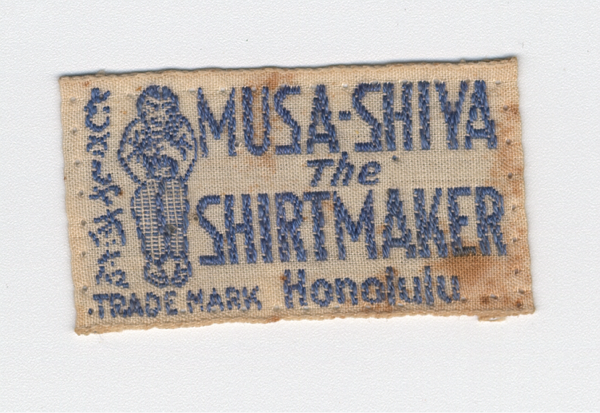
> In every ad, Miyamoto included the logo of his store: a racist caricature of a smiling Japanese man clad in a kimono, known as Musa-Shiya the shirtmaker.
Is it really fair or right to call it 'racist' if it's someone's of that ethnicity?
I suppose the obvious other example is black people calling each other something that would certainly be racist if I did it. I know that's controversial, but even that I don't think people would call racist?
Or gay people 'reclaiming' slurs - it's not homophobic.
I think the problem is the buyers are not necesirely included right?
Like a black person making a song with the n-word and singing it offends no one, a black person in the audience singing it offends no one. But when other people sing it at the top of their lungs then a discussion happens (some people are ok with it others arent).
Similarly, an asian man drawing himself in an exagerated way and wearing it himself might not be a huge issue but if other people wear it then it can get muddy.
I think in this case, being the label on the neck tag, and being a kind of drawing is prob not a thing that affects almost anyone, but the drawing is slightly eye brow raising nowadays
I think this can be a complicated and nuanced discussion that unfortunately can be difficult to have on the internet (even HN!) without devolving into flame war
My answer is that it largely depends on the context and power dynamics, so it’s hard to say whether a caricature of a Japanese man is racist when made by a Japanese-American business owner
In 1930s America I would lean towards racist, i.e. denigrating towards Japanese ethnicity for the sake of appealing to / surviving in an oppressive culture. That’s not a statement of indictment on the business owner but the environment that the business exists in.
That said, Hawai’i is quite different culturally and demographically from the rest of America, so I genuinely don’t know in this case. If this were New York or San Francisco, especially if outside a “Japan town”, i would absolutely say it’s racist.
Perhaps, but to the extent that the author is calling Mr. Chun's credibility into question, it seems important to get this bit right.
According to Wikipedia, [1] it looks like he trademarked it, and held onto it for the next 20 years. It doesn't say what happened next, but apparently there is now a trademark for "the original aloha shirt since 1936" — very specific! [2]
That gives me a tangential thought. I'm not a lawyer, so I'd be interested if one specializing in trademark could chime in. Is there any kind of veracity requirement for a trademark? Or is it simply a matter of uniqueness. For example, could I register and then market a paint as 12,000 BC Cave Paint(tm), so long as nobody else beat me to it?
My strong hunch is that there is no such requirement.
For a very good new aloha shirt, try the Cooke Street shirts sold at Costco.
These are 100% cotton, and they take the trouble of aligning the pattern on the breast pocket to match the rest of the shirt. I call it the "invisible pocket".
Availability varies quite a bit from store to store. We usually shop at the Redwood City (CA) Costco, and last year I didn't see any Cooke Street shirts, only some off brand made of rayon with misaligned pockets.
This year they had the Cooke Street shirts again, but I think the RWC buyer is a bit insane. It seems like they purchase the same number of every size, so if you don't get there early in the season, they only have a few if any medium or large sizes, but plenty of XS and XXL.
We tried Mountain View, but they didn't have the Cooke Street shirts at all!
On July 3rd we went to SF for the morning, and on the way back I said "let's stop at the South San Francisco store". I was in heaven! They had plenty of every size and every pattern. So I bought about 24 shirts, two of each pattern. That should hold me over for a while!
If you love aloha shirts as much as I do, try these.
My spouse worked for Tommy Bahama in Seattle. They used to have an employee sale for $5 fitting versions (test garments for models or sales reps to try) or rejects they wouldn't send to nordstrom rack... usually would have a very minor flaw. Sometimes a bit more. Got a blazer with a shredded liner for $15 for instance. Or a shirt missing 2 buttons.
First time I handed them $100... got 20 shirts... Second time they complained that they didn't have big enough bags. I asked how much I could spend. They said $500. So I just gave my spouse ikea bags and $500 every 6 months for a few years. They came back with 250 worth of stuff in totally full ikea bags. I have several rubbermaid tubs of tb linen or silk shirts now. The joke was that I'd get one shirt per day of the year before she rage quit.
Not sure I'll ever need to buy a shirt again. Or semi formal wear ever. They make nice stuff esp if youre not paying retail.
I wear a barkcloth aloha shirt when the temperature gets above 40C (~105F) and humid because it wicks sweat well and holds its shape. Wearing one on a motorcycle is better than air conditioning. They're classic, comfortable, welcoming, and appropriate almost everywhere if they are actual barkcloth (not fake and cotton), and you are basically fit.
You need to have a certain level of confidence and self-acceptance (and coin for a real one) to pull one off, so socially they can be a great filter as well.
Except the texture of regular cotton shirts is what disqualifies them. I am referring to barkcloth as the texture and thickness, and not the poplin and polyester that characterizes cheap immitations. I mean sure, you can wear some representation of an aloha shirt made of velour if you wanted to, but it doesn't carry the same comfort, or appropriateness.
Well in the animated Disney documentary Sword in the Stone we see Merlin come back from from Bermuda wearing Bermuda shorts and shirt so we can surmise it's always been the garb of wizards ; ).
I actually have some and I like projecting an air of fun since I'm an introvert.
Palmer said it was just what was in the closet after not caring for long enough and receiving hand-me-downs from his father, when he tried to change his style once he had some time to do so everyone gave him so much trouble that he just stuck with it.
if you're asking if there is some business acumen hidden within the decision, well then I ask how one would fit the Jobs turtleneck into the ensemble?
The story goes that an IBM suit found themselves indispensable enough to negotiate the dress code requirement out of their contract, and then later founded Seagate.
The point is that there are folks who are smart or competent enough that it doesn't matter what they wear. Ultimately it is a uniform nonetheless.
Hawaiian patterns probably tend towards a particular vibe. However, there are a lot of shirts in a similar shirt style and pattern design throughout a lot of the tropics. I have shirts from Indonesia and Thailand--and even just from the brand Patagonia--that aren't really Aloha shirts but they're loose, breezy, buttoned-fronts with colorful designs that aren't all that different either.
My fiancée used to be a designer at a pretty big label not too long ago.
It always amazed me how the stuff she’d sketch sitting next to me on the couch would wind up in stores months later.
Anyway, over the years I’ve learned lots of little tidbits here and there about clothing and fabric. One such tidbit is that what differentiates a Hawaiian shirt from something like a Cuban shirt or otherwise similarly printed shirt is the open collar (and the material of course).
Naturally, once you learn stuff like that you really start noticing details on clothes etc. Many times I’ve been at a store where there’s a “Hawaiian” shirt on display with the wrong material and wrong collar. Amateurs.
They were brought to Thailand during the war, and now it's the national shirt for Buddhist New Year (Songkran). I thought it was a coincidence but they adopted it as the local shirt.
The article doesn't get into this much, but I had thought there's a distinction that "Aloha shirts" have not-too-loud patterns (often reverse-printed) that would actually be worn in Hawaii, where "Hawaiian shirts" look more like children's shower curtains.