What the police can ask for legally and what they ask for based on a credible threat are rather different.
If 99.99% of the people comply and .001% of the people refuse and the cop involved slugs the non-complying person, giving them a life changing injure. and even if that cop "doesn't get away with it" - gets filmed, get drummed out of the force and the city pays a million dollar settlement, the cops, collectively, will still get away with it and keep doing it since it nearly always works. And the one cop being caught is extremely optimistic.
Even with suspicion, it's unlikely that they can forcefully demand social media information.
How can a cop request information in fashion that isn't forceful? The softest, most polite question is backed by the threat of both violence and arrest.
> How can a cop request information in fashion that isn't forceful? The softest, most polite question is backed by the threat of both violence and arrest.
This is an American-centric attitude towards government and government representatives. The power the government holds over you and I is a monopoly on violence (defined broadly) that they license to specific representatives to enact their will in order to form some loosely held cohesion among chaotic ideas. More simply put, something has to stop us from taking something that is not ours out of perceived hierarchial need.
I'm a liberal man raised by classically conservative parents, the lessons I was taught as a young man were that the government by it's very nature always wants more power and to exercise that power over you. More simply put, if you give an inch the government will forcefully seize a mile. As a result I was taught that innocent men go to jail all the time for a litany of reasons, most of them bullshit to laypeople. This is the foundation of healthy distrust for government and government representatives. There are counter-balances we carry with us, as a yin and yang of sorts.
So, with that explained, how does one take a request for information as non-violent? You don't. You expect that the government is willing to enact it's monopoly on you and choose to seek the most amicable (for you; which is likely less violence) solution. You exercise your fifth amendment, you request representation, and if the representatives so desire it the best you can do is hope to represent your claims at trial. Democracy is fought in the court room, not with the enforcement representatives of government.
The government has won. I say that because the majority of the people in this country are living paycheck to paycheck and they cannot afford any hiccup or else they will be underwater. From there it is an easy spiral down to the bottom. They cannot afford good counsel or even afford to take time off to fight this. This is the perfect environment for a population that will not fight back.
The only hope is that people who are able to fight back do fight back for the rest of us. However we have seen that many people who are able to do this benefit from the current situation. Effectively 80% of this country live to serve the other 20% and thats why I believe we don't see as much progression of many areas as we should.
Agreed. From my perception people knew the system is and always will be imperfect, and relied heavily on the idea that not all people can afford to fight the government, but that at some point the government will mess with someone who can. Democracy in the US is like standing on the shoulders of giants who bravely carved the way ahead for us. One of my favorite examples is Larry Flint who lost his ability to walk, much less his representation as human among other humans, for the principles of free speech. Although you may not agree morally with Larry Flint, you likely stand in his shadow when you say things other people and the government don't like.
That said, when the middle, and upper middle class are so squeezed that they cannot fight the government anymore -- then who is left to? When economic (or class, whatever your favorite rhetoric) mobility has chilled, who will rise to the ranks of those who can fight who have memories of the time when they could not?
Anyway, this is the way these problems are postured in my mind.
> the majority of the people in this country are living paycheck to paycheck and they cannot afford any hiccup or else they will be underwater
While possibly true, that doesn't necessarily mean they are poor. Plenty of middle class people operate on see-money-spend-money. There were plenty of them at Boeing when I worked there - the paychecks were distributed on Thursday morning, and at noon a flood of engineers would run to the parking lot to deposit the paycheck before the checks they wrote bounced.
This number is probably the truest measure of a person’s real wealth: What is the largest unexpected financial shock you could sustain without the cost of that to you suddenly becoming ten times the original cost or more? That number isn’t something easy to calculate; it depends on whether you have a family that can help you out, on your income, on whether that shock involves losing your job (and thus your health insurance, if you live in the US), on whether you have access to any other sources of security (including public assistance).
From Yonatan Zunger's "Your 'Financial Shock' Wealth".
Other commentators have similar arguments. Economist Emma Rothschild makes the explicit point that Adam Smith's "liberal philosophy" was one of material liberty, that is, of an abundance of material wealth at the individual level, which allows for a freedom of actions without catastrophic consequence.[1] Several recent modern commentators have noted that the chief characteristic of poverty is a lack of choice: if there's only one way to do things right, without consequence, you have no freedom.
Among Zunger's references is the point that very nearly a majority of US households, 47%, cannot sustain an unexpected $400 expense.
Whether or not living paycheck-to-paycheck is necessarily a characteristic of poverty is of course debatable in specific instances. But one cannot look broadly at the population of the US and claim both that market economics succeeds on the basis of individuals making intelligent and rational economic decisions and that many millions of those people, very nearly if not majority of those same people fail to do so.
Something is very rotten in the "free market".
________________________________
Notes:
1. I'm trying to track down the Emma Rothschild reference, though I suspect it may be in Economic Sentiments: Adam Smith, Condorcet, and the Enlightenment.
That "47% can't sustain an unexpected $400 expense" conclusion does not follow from the actual survey data involved, as far as I can tell. See https://www.cato.org/blog/it-true-40-americans-cant-handle-4... for some details (yes, you may not trust the source), or the actual response data at https://www.federalreserve.gov/publications/2018-appendix-b-... questions EF3, EF5B, EF6B if you want to do your own analysis. The only way to get numbers in the range "47%" out of that data is to add up _all_ the choices other than "put it on my credit card, which I pay off in full" and "just pay cash" in the EF3 responses. But that's an odd thing to do, given that respondents were instructed to select all the methods they would use, not just one method.
Fair point, appreciate your digging out the source. Interpretation of survey responses is ... challenging.
The question works well to answer the question "what sources of emergency financing do you have access to?" It's less well-structured to answer "could you pay for an emergency expense without either selling off nonfinancial assets or incurring long-term usurious debt".
Since multiple selections apply, adding percentages isn't applicable. Though 50% of respondents do mention paying with current cash savings --- that could apply to all or part of an expense.
I do read "unable" and "by selling something" as mutually exclusive, which suggests a 20% portion of the population at least who'd be severely stressed by such an incident.
I really wouldn't assume those are mutually exclusive, based on my experience with survesy, but I agree that 20% is likely smaller than the actual number here. And 14% is an absolute lower bound which assumes that no one checked both "charge and pay off" and "pay cash", which is clearly an unrealistic assumption.
Even 14% is much higher than I would wish for answers to this sort of question, of course.
Anyway, if I had to read the tea leaves I would guess the "real" number is somewhere in the ~30% range based on EF5A and EF5B (EF5B was only asked if the respondent answered they would pay all bills in full for EF5A). That is, 22% of the respondents are having trouble paying existing bills in full (though what that means is another complex question, I bet) and another 11% (14% of 78%) would have trouble doing it if they had an unexpected $400 expense. That gets us to 33%; some of those might be able to recover from the $400 expense over the course of a month or three by temporarily running a small credit card balance and then paying it off, but it's not going to be too many I expect.
Which is pretty horrible. Not 47% horrible, but horrible.
These paycheck-to-paycheck middle class people are not poor. They live rather high on the hog. It's your neighbor with his and hers new cars, and a ski boat on a trailer in the driveway. No matter what their income, they spend it all.
You can feel sorry for them if you like, but I don't.
You seem to be missing or ignoring much of what I'd had to say above.
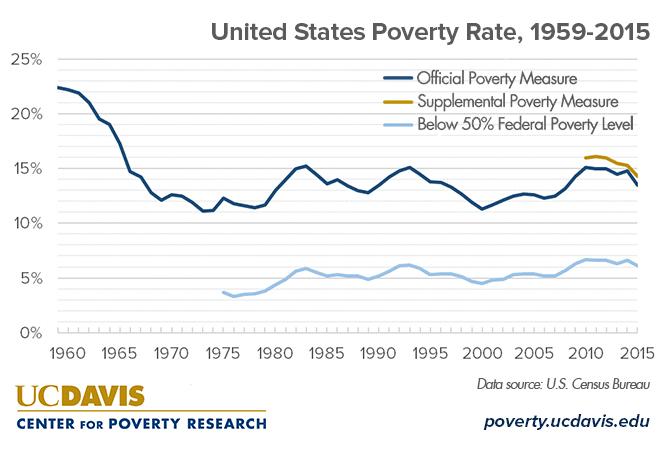
50 millions live below the Federal poverty line.
47% of Americans cannot meet a $400 emergency expense.
You deny their poverty?
Your personal experience with a comparatively small cohort of Boeing engineers and employees may have been illuminating in any number of degrees. It's a poor basis on which to make assessments of national wealth, poverty, and/or inequality. And even if it were, it still knocks a rather major hole in a foundational premise of free-market economic theory.
Robust sampling and measurement methodologies exist for quite substantial reasons.
> 47% of Americans cannot meet a $400 emergency expense. You deny their poverty?
Yes. You yourself posted: "About 15% of the US population (50 million people) are at or below the Federal poverty rate." You refuted your case.
> small cohort
I've seen these middle class people everywhere I've worked. They're not a "small" cohort. In fact, most of the people I've worked with fell into this category. As far as I could tell, I was the only engineer in the office building who did not deposit the paycheck the same day. I know this because others expressed shock that I didn't.
> it still knocks a rather major hole in a foundational premise of free-market economic theory
No, it doesn't. These people chose to behave this way. It's their right to. Nobody made them buy the boat. One of these boating people would sell his boat when he needed cash, and when he had cash, he'd blow it all on another boat, or a new car, or an RV, or whatever caught his fancy. Free market theory posits that people have a free choice. Not that what they do makes fiscal sense to anyone else.
> It's a poor basis on which to make assessments of national wealth, poverty, and/or inequality.
How much cash is in your bank account is a very, very bad assessment of wealth, poverty, and/or inequality. But that's what you're putting forward.
For another example, I have next to $0 in my checking account, and don't have a savings account. But I'm not poor, even though you'd classify me as poor. I keep it all invested. I only use cash as a transfer mechanism.
P.S. I actually did have a boat once (!) and me and my friends had a couple marvelous summers waterskiing on Lake Washington.
Almost all the young (20s and under) people in my businesses that work low wage jobs have no qualms spending $15 to $20 ordering food delivery for their meals during their shift.
I and most of the rest of management bring leftovers from home or eat a yogurt and some fruits and nuts. My parents would have been very disappointed in me for spending that much on delivered food, especially with how low quality and mal-nutritious it is.
> 47% of Americans cannot meet a $400 emergency expense.
As I pointed out above, this does not seem to be a correct interpretation of the actual survey data involved.
> You deny their poverty?
Yes, given that the claim is based on a misrepresentation (or, more charitably, misunderstanding) of the actual survey data.
I do not deny that there are plenty of people in the US who are in terrible financial shape and really would be thrown for a loop by a $400 expense. They do not make up 47% of the survey population.
The other interesting question that I do not have an answer to is whether the survey sampled individuals or households, and hence how to translate the survey percentages to population (of non-dependent adults?) percentages.
They may not be poor, but the point is that if you live like that, and get arrested, even if you are innocent and released within a few days, you may have lost your job in the meantime, or have incurred fees that you can't cover, or something else the knocks down the house of cards that is your finances. It doesn't matter if you make minimum wage, or $300k/year. If you spend all of your paycheck before the next one arrives, any unexpected cost is going to break you.
A huge imbalance is money, specifically enough to have a lawyer appear on your behalf ASAP. Those with means usually won't ever see the inside of a holding/processing cell because there lawyers are there before they are booked.
This means they need to bail hearing, since the lawyers will even demand immediate bail based on charges.
No jail time, not even 24 hours. No dealing with bail bondsmen. That is huge. Most jails only offer free calls within their area code. Not being in jail means their life continues uninterrupted, as does their job/income. A poor person will likely lose their job if they can't afford bail, as they are stuck an inmate until their hearing. If their public defender is backed up, which they always are, they will likely push thw court date back for more time.
It's just a complete nightmare. The rich have straight up taken control of everything, including the government.
I'd more say that "the US hates poor people". It doesn't help me, as a rich person, that poor people get screwed by the government regularly & repeatedly. In fact it makes my life much worse in a bunch of ways.
Most people everywhere on the planet are either living on today's wages or are dependent on the government itself. In a sense, even if you have financial freedom, you're still dependent on the government ensuring that freedom continues. Money is paper without the body behind it.
If you require a safety-net to speak up for your rights, be prepared to lose them.
>> How can a cop request information in fashion that isn't forceful? The softest, most polite question is backed by the threat of both violence and arrest.
> This is an American-centric attitude towards government and government representatives.
Of course, you're right. The US does have this unique tilt. it's not all bad, IMO, good to have some distrust of those in power.
But the real problem is decades worth of thuggish behavior by police officers. The awesome power we grant them is sought out by those who would abuse it. This is compounded by 20th century crime and violence which caused police forces to ratchet up their process for dealing with the public to treat each interaction as potentially life threatening.
So the real threat is implied by the unpredictable reaction when you describe the limits of the police officers' power. Some would recognize their bluff has been called. Yet others would double down.
If there were no implicit threat of violence, I (and most other people I think) would never stop for a cop in the first place, let alone utter a word to one.
A wide variety of government authorities occasionally walk around and talk to citizens - zone officials, fire fighters, etc. People talk to them without them carrying any threat of immediate violence (they carry the threat of later legal action sometimes but that's different).
You might be right about the cops depending on how you mean it. Now, American police may well have created some much distrust in public no one would willing speak to them, everyone would prefer some other level of authority. If you mean effective policing in general requires the constant threat of violence, I'd disagree with you there.
If people thought the reward for talking to a firefighter was a hundred dollar fine, they wouldn't be so willing to casually chat with firefighters either.
This is exactly why in the U.S. when there are evacuations for things like hurricanes, most towns and cities sometimes send firefighters to knock on doors and notify people. They used to send cops, but too many people simply wouldn't come to the door.
It depends on the situation. I have been approached by cops twice--and had no problem with talking to them.
The first case involved a detective investigating an accusation by someone we knew against someone else we knew. There was no suggestion we were anything but observers, no reason not to talk.
The second time was out at a trailhead, I had just finished a hike. They were working with search & rescue extracting someone who broke a bone. They correctly deduced where I had been and came over and asked about the snow conditions high on the mountain. In hindsight I was a little annoyed at how they asked it as I responded a bit too literally--addressing the snow conditions but forgetting the three trees that had fallen across the trail, one of which would have been a substantial obstacle to a stretcher evacuation.
In a working system you stop because someone needs something who provides a valuable service to society. And, we are all part of what makes that system work. That said, the USA does not seem to be there yet.
> In a working system you stop because someone needs something who provides a valuable service to society. And, we are all part of what makes that system work. That said, the USA does not seem to be there yet.
Personally speaking, I don't think the American ideology will ever lend itself to this idea. Our country was born out of revolution and inherent distrust for government. What you're describing seems to align itself more to a world where citizens have a cooperative relationship with government. Both attitudes have ups and downs, strengths and weaknesses, and potential vulnerabilities in my mind.
Australia was originally settled (by white people) by criminals and their prison guards, by your analysis we should be a bunch of people who never talk to the police. However this is not the case, most people will happily give the police assistance if they are asked. Whilst dobbing people in directly is not something that is in the culture, generally we don't fear the police.
Could be something to do with the fact that the police don't generally draw their weapons unless faced with violence.
Of course there are areas where policing is more direct and there are groups that have been historically given a hard time by the law, but these are comparatively small.
To my recollection the Australian government was formed because the colonies voted to unite in 1901. American government was formed to fight the British.
That is a warped view of history IMO :), America was born out of the idea that we can make a better place for everyone, one where everyone counts and has a chance to build the life they want (historically a big one was to practice their religion without discrimination as well). It wasn't born out of revolution, it was born from people escaping British society in order to live a better life. And, regardless that was a long time ago, we've reinvented it since then, it is a land of immigrants who want to build a better life for themselves.
I believe American Culture is one that supports each other and society, we have just lost our way and we are in a bit of a battle for the soul of America. It is being hijacked by super individualist who forget they are part of something bigger and that they have a responsibility to society as much as society should respect the individual.
If you have a bike accident people will stop to help. If your car breaks down, people will stop and help. If you have a medical emergency, people will stop and help. If you need directions people will help. The media likes to show fear and we think that is the norm, when in fact the vast norm is that we are always going to help our fellow humans. Cops are still human, despite really bad training that causes them to fear everything and everyone. If a cop asks you to stop and the only thing that makes you stop is the threat of violence I would seriously rethink who I am and my values.
> If a cop asks you to stop and the only thing that makes you stop is the threat of violence I would seriously rethink who I am and my values.
People who deliberately speed don't accept speeding tickets out of civic duty. If you accidentally went five over and are embarrassed by your mistake and want to make it right by eagerly paying the fine, good for you I guess. But if you are instead deliberately doing double the speed limit because you think it's fun and don't care about the law, you are clearly not the sort of person who is inclined to willingly accept the ticket because it's the right thing to do. If you were that sort of person, you would not have been racing your car on public streets in the first place.
There is not a country on this planet in which nobody ever chooses to willingly break the law and flagrantly act in antisocial ways. And there is not a country in this world which will not eventually resort to violence when all else fails to convince a criminal to stop committing his crime. You might be thinking that if the cops don't have guns, then what they do isn't violent. But if you think that, you're obviously wrong. Unarmed well trained police will still wrestle you to the ground when all else fails. Unarmed police officers won't shoot you for refusing to comply, but they sure as shit will manhandle you to the ground and wrestle you into handcuffs. That is violence, and the implicit threat of that violence is used to convince people to go along with them peacefully in a dignified fashion.
That's when our first/temporary government was formed, and it's purpose was the fight the British.
> I believe American Culture is one that supports each other and society, we have just lost our way and we are in a bit of a battle for the soul of America. It is being hijacked by super individualist who forget they are part of something bigger and that they have a responsibility to society as much as society should respect the individual.
We are a nation that celebrates political individualism, which is where the term "liberalism" (little L) comes from: https://en.wikipedia.org/wiki/Individualism Individualism is not at competition with the characteristics you described, but it does put freedom squarely on the individual for better or for worse. The counter to this, which you might favor in the moment but regret in the long-run, is collectivism.
If I choose to drive 80mph in a 60mph zone, I am also going to choose not to voluntarily stop to receive a fine for it. I don't believe the average European is any different. The implicit threat of violence in Europe might be more tenuous, indirect or vague, but it is still there. Normal people don't voluntarily fine themselves if they have another choice.
A common assumption is that when dealing with the Police in the US the problem isn't that they will operate within the law and apply it as intended to punish you but rather that they will not operate within the law which almost invariably end with someone getting needlessly harmed.
So the issue isn't that you're speeding, the Police stops you and writes a $50 ticket. You voluntarily speed and voluntarily stop for the fine because you voluntarily try to avoid a bigger punishment under that system. The problem is that you're speeding, the Police stops you, overreact, pretend they saw something dangerous (smelled marijuana, something looked like a gun, you were acting suspiciously, had the wrong skin complexion, etc.), you get pulled out, roughed up, hurt, or killed.
Even if I were to assume that all police officers are perfectly honest and reasonable, virtually anybody who is choosing to break the law would also choose to not voluntarily subject themselves to the consequences. Nobody chooses to speed down the highway then calls the local cops to confess and accept the fine. And if police sirens were nothing more than polite requests to pull over, not demands backed by implicit threats of violence, virtually nobody who is choosing to break the law would heed those requests voluntarily.
But policing requires the trust of the public. How often, what percentage of interactions go not by the book, before people are worried that it will happen to them? Look at 9/11, so many people terrified of "terrorists" from a desert on the other side of the world while ignoring the local ones who had a pretty strong spree in the 90s.
Trust is earned, not given. Police and supporters can cry all they want about how rare it is for a police officer to shoot you with no reason or warning and get away with it, but the fact that it can happen more than once is enough to destroy any faith in policing for plenty of people
> A common assumption is that when dealing with the Police in the US the problem isn't that they will operate within the law and apply it as intended to punish you but rather that they will not operate within the law which almost invariably end with someone getting needlessly harmed.
I read a lot of nonsense about the US on Hacker news everyday to the point that it doesn't really bother me that much anymore (I assume it's just temporary ignorance that enough real life experience and context will clear up), but this does bother me for some reason. It's one thing to misrepresent the scale of something or not understand the nuance of something, it's another thing to literally make things up.
> If I choose to drive 80mph in a 60mph zone, I am also going to choose not to voluntarily stop to receive a fine for it
What nonsense is that? It's only the fear that the police officer will beat you that will cause you to stop. Not that you might wake up tomorrow to a towed car, a summons nailed to your door and a jail term?
> Not that you might wake up tomorrow to a towed car, a summons nailed to your door and a jail term?
Both enforced through the implicit threat of violence... What happens if I ignore a court summons? Eventually the cops will find me and wrestle me into handcuffs. And if I try to resist the tow truck driver taking my car, guess what they'll do? They'll call the cops. Or they'll put a lien against my property, which if I refuse to pay, will eventually culminate in me being wrestled out of the building.
And how exactly do you think people are kept in jails? If there were no implicit threat of violence, I'd just walk out of a jail. In many jails this would be possible, but when you do they'll send men to wrestle you into handcuffs and bring you to a jail with stronger security. And of course, they'd never have gotten me into the first jail at all, if not for their threats of violence.
> If there were no implicit threat of violence, I (and most other people I think) would never stop for a cop in the first place
I think this is outlandish. Most people are law-abiding and happily comply with the law and government authority without any threat of violence. I don't think I've ever had it factor into my decision-making.
> Most people are law-abiding and happily comply with the law and government authority without any threat of violence.
Most poeple have never had a practical opportunity to decide whether or not they will choose to comply with the law or government authority without any threat of violence, because the threat of violence is always present if they fail to comply.
This obviously does not mean that people would never comply if the threat of violence were removed. Much of the time the law aligns with what people would choose to do anyway, so compliance comes naturally. The interesting case are those where natural inclination is at odds with the law (or with the orders of a government official), and in those cases I think you might be overestimating the average person's willingness to comply without being forced.
You have taken a theoretical question - the definition of sovereign government and the monopoly on violence - and applied it to reality. It's Alice In Wonderland stuff. That's not how real people function, including (almost certainly) you.
> You have taken a theoretical question - the definition of sovereign government and the monopoly on violence - and applied it to reality. It's Alice In Wonderland stuff.
I'm not seeing an issue here. Theory which one cannot apply to reality is rather pointless; wouldn't you agree?
> That's not how real people function, including (almost certainly) you.
Which part are you objecting to, exactly? That (a) people tend to follow the law when it aligns with what they would have chosen to do anyway, or that (b) they tend not to constrain themselves to following the law when the law doesn't align with their own moral standards and no one is plausibly threatening them with violent repercussions should they fail to comply?
Why does there have to be an implicit threat of violence? If you didn't stop, the cops could take your license plate, find where you live, and send you a ticket for a much bigger crime. Cops don't have to use violence to solve all their problems.
If you continue your scenario, so that the subject refuses compliance even further -- does not pay the fine, ignores court summons -- physical coercion crops up when they are arrested, and perhaps later sent to prison. This may not be "violence" as you meant it, but it is one aspect of what people mean when they say "state monopoly on violence".
If you don't stop, cops will happily chase you in violation of department policy, endangering innocent bystanders[1], then shoot you when you are running away. If you happen to get away the next step is sending a paramilitary team to your house to shoot your dog and throw a flashbang in your baby's crib.
>Cops don't have to use violence to solve all their problems.
They don't have to, but its usually the first resort. There's literally thousands of hours of videos online of cops knowingly making illegal 'requests' on video and threatening arrest for noncompliance.
[1] I had to ride my motorcycle over a curb because a police SUV somehow thought he could outrun a race bike and came flying around a blind stop sign in my neighborhood at a fast enough speed to hit the opposite lane. Policy in my city is no pursuit.
Fake plate or stolen car and you probably can't prove who was driving anyway. That's why camera tickets are generally just fines to the registered owner, no points to the actual driver.
If a police officer has given you a life changing injury simply for refusing to disclose your Twitter account, we've left discussion of the law and what the police "can do" and entered a discussion about what to do about the problem of overtly criminal police. Nobody could have paid attention over the last 2 years (or the last 20) and come away believing there aren't criminal police officers; that is a real thing. It has not very much (some, but not very much) to do with official LAPD policy or their incident questionnaire cards.
But that just brings me back to my point about the framing of this article. If The Guardian believes this question is problematic --- and I agree with them, if they do --- they should write an article about how you don't have to tell the police anything about your Twitter account just because they've stopped you on the street.
> we've left discussion of the law and what the police "can do" and entered a discussion about what to do about the problem of overtly criminal police
I genuinely think this point has long since come and gone. Most encounters with police are going to end fine, but there's basically no recourse in the majority of cases where they don't.
I'm not saying that's not true, I'm just saying it's a totally different conversation. In the world you say we're in, it doesn't matter what LAPD's policies are. The police will just ignore them and do whatever they want.
The situation is that American police are generally there to enforce the law, generally follow policy but, depending on area, are infested with a minority of types who use or threaten violence whenever it makes their job easier or simply serves their ego. And these forces also tend to have a much larger group who won't say anything about the overt criminals - out of conformity, alienation from civilians or because the intimidation factor is convenient to them. This situation, that is effectively well publicized at this point, fundamentally changes the way police and civilians relation because it goes a lot of police actions a threatening quality and so, as I said earlier, it's hard to have question appear "optional" to the average person stopped by the police.
> How can a cop request information in fashion that isn't forceful?
They can explicitly inform you that you are under no obligation to accede to the request and will face no adverse consequences if you choose not to.
Except where explicitly legally mandated to do so, they do not tend to this, specifically because even if it is true, they wish people to perceive and act upon an implicit threat of violence for noncompliance.
>How can a cop request information in fashion that isn't forceful? The softest, most polite question is backed by the threat of both violence and arrest.
I agree, but also they are pretty well trained in scripts for extracting confessions/assent for searches/etc. People simply don't know the law and there's always the hope you'll catch a break.
If Live PD were still on, you'd notice how often the same phrases are used throughout the US. It all sounds like a lawyer wrote scripts for traffic stops and that those training materials were used nationwide. 'honesty goes with me a long way' 'you are being detained you are not under arrest' or whatever.
If my boss is making small talk, and asks what I did at the weekend, of course I am under no obligation to tell him. I can tell him it's none of his business, and I'm quite within my rights to do so. Some people would.
But in the long run, whether it's right or wrong, not answering probably makes my life harder (passed over for promotions, etc.).
So I don't ask this question from those who report to me, because I can't easily ask it in a way that doesn't seem to carry an obligation to reply.
And neither I nor my boss have a gun and a pair of handcuffs.
> How can a cop request information in fashion that isn't forceful? The softest, most polite question is backed by the threat of both violence and arrest.
With a smile and a calm voice. Do you really believe every single cop is going to punch you if you don't comply?
It's the same as how a burglar "can't" rob your house. Of course they can, and then you get to attempt legal recourse afterward, which sometimes works.
Especially given that the officers were told by higher-ups, you wouldn't want to press criminal charges against the individual officer anyways - you'd be better off with a civil suit against LAPD.
Legal recourse? I suppose people could maybe bring civil suits against burglars, but generally they face criminal charges, and you make an insurance claim?
It's not that bad. No, really. If a cop pulls you over based on speeding and asks for anything else unrelated to that, you simply and politely decline. It's very rare that a cop will risk their job or go through the hassle of taking people in simply for exercising the 4th or the 5th amendment. As a citizen you have many avenues for recourse, your cynicism is unwarranted.
Simply and agreeably assert your rights. More people do it than you think.
And then the cop calls for the drug dog, and suddenly, you're dealing with a dog trained to please it's handler, which in this case means telling the cop that you have drugs in your car. And off to jail you go. As far as the cop is concerned, his thuggish behavior is now vindicated because you're a drug dealing degenerate.
Alternatively, the cop uses a bunch of highly sensitive field drug tests on your car and gets a false positive. In america it seems that's enough to jail people. And then they lose their jobs, their home.
And the SCOTUS has already ruled that a cop cannot make you wait for a drug dog without probable cause (Rodriguez v. United States 2015). So in your scenario you've got a cop who is willing to break the law, and in that case all bets are off.
SCOTUS has made many rulings that cops both know and regularly ignore. There's hundreds of videos online of police threatening a camera person with arrest if they don't provide ID and then blinding or obstructing the camera. All three of those have been explicitly ruled on and leave no question, yet they continue to do it en masse.
“I smell marijuana” is probable cause… it’s been weakened recently, but probable cause doesn’t have to be proven. “Bloodshot eyes” is another one that works for DUI cause.
> You’re not going to jail unless you have drugs in the car
No, you aren't going to jail unless the search “justified” by the drug-dog “hit” reveals something that the police can spin into probable cause of a crime.
The usual full expression is something like “probable cause to believe that the person to be arrested has committed a particular crime”.
> "Probable cause" can be used to justify a search.
“Probable cause” is a constitutional requirement for search warrants, arrest warrants, warrantless arrests, and warrantless searches; for searches, the probable cause is that the search conducted will uncover evidence of a crime, which is different than the probable cause for arrest.
> You would need to actually be suspected of a crime.
Well, no, there needs to be probable cause to believe you've committed a crime. Actual suspicion is a much lower standard.
> If the cops don't find drugs, what crime are you guilty of?
There are...like thousands of other crimes, and millions of possible configurations of things that are not drugs that could support probable cause to believe you've committed one of them. Spray paint cans consistent with a recent spate of vandalism (graffiti) in the area is one I’ve personally seen used, beyond things that are inherently actual or apparent contraband, and the “actual or apparent contraband” category extends to more than just drugs.
In america you can be hauled in and convicted of nothing more than "resisting arrest", with no other prior crime or suspected crime. If a cop tries to arrest you and you do ANYTHING other than comply, that's a crime
> Yes, but without evidence you aren’t going to jail, and if you do you can sue for wrongful arrest.
You can sue anyone, anytime, for anything, but even if charges aren't filed or a court dismisses them at the preliminary hearing stage for lack of sufficient evidence, wrongful arrest suits against police are very difficult.
> "Probable cause" relates to searching or entering private property.
It also relates to arrest. The Fourth Amendment provision applying the standard explicitly applies to searches and seizures of persons, houses, and effects. Arrest is seizure of one’s person.
There's plenty of DUI arrests where no drugs are present, the driver blows 0.00 on the breathalyzer, and the only "probable cause" for arrest is an officer's subjective "expert" opinion.
People have been arrested because the police claimed that a standard dose of Tylenol the night before was driving under the influence of drugs or alcohol. If a police officer wants to take you to jail you're going to jail.
There was a guy I read about recently who was arrested and jailed on suspicion of methamphetamine possession for Krispy Kreme donut sugar found in the floorboard of his car. He was released once the lab determined it wasn't meth, but he did go to jail.
> Simply and agreeably assert your rights. More people do it than you think.
Police culture in America is based around disgust and disdain for the notion of “rights”. You can try standing up for your rights, but that is likely to be responded to with “stop resisting!” and a subsequent (constitutionally protected) physical assault.
This might be true if police brutality and disregard for rights were new problems, but they're not. The reason these problems with the police are finally being discussed is because there are cameras everwhere now.
There's no way to agreeably assert your rights. The cop wants something from you, and you're saying no. Being extra polite merely increases your chances of a neutral interaction, but you're already starting off on a negative feeling.


If 99.99% of the people comply and .001% of the people refuse and the cop involved slugs the non-complying person, giving them a life changing injure. and even if that cop "doesn't get away with it" - gets filmed, get drummed out of the force and the city pays a million dollar settlement, the cops, collectively, will still get away with it and keep doing it since it nearly always works. And the one cop being caught is extremely optimistic.
Even with suspicion, it's unlikely that they can forcefully demand social media information.
How can a cop request information in fashion that isn't forceful? The softest, most polite question is backed by the threat of both violence and arrest.